
Midwest City Archive Records
Midwest City city-directory research begins with a boundary: the Oklahoma Historical Society directory search has City and Year fields, but the direct Midwest City query returned no indexed match. The result does not show that no printed directory ever existed. It shows that an online search did not expose a run. The best next stops are the Oklahoma Historical Society Research Center, Metro Library, its Special Collections staff, and Gateway to Oklahoma History. Each holds a different kind of lead, and each should be recorded by collection title, date, and access route.
| Collection | Years | Where held | Access |
|---|---|---|---|
| OHS City and Year directory index, Midwest City query | No run returned | Oklahoma Historical Society | Online query, then Research Center follow-up |
| Regional Oklahoma City volume holdings | 1889 through the 1940s | Oklahoma Historical Society Research Center | Reading-room, microfilm, Ancestry, or other listed access |
| Midwest City and area school yearbooks | 1945, 1948, 1949, 1952-55, 1963, 1967-68, 1972-73, 1978-80, 1994-95 | OHS yearbook listings | Search by school and year; availability varies |
| Gateway historical item, Midwest City government | June 1976 | Gateway to Oklahoma History | Online item metadata and image |
The regional Oklahoma City holdings include McAdam-Levy, Chittenden's, Western Directory, Times-Journal, Warden/Hoffhine, Worley-Friss, and Polk's titles. They can help explain nearby regional coverage or a family connection, but they are not proof of a Midwest City address. The 1942 founding of Midwest City also matters when judging older volume dates. A volume published before the city existed cannot serve as a Midwest City household source.
Note: Preserve a no-result search with its city field, year choice, search date, and repository name rather than turning a missing online result into a negative claim about a person.
Midwest City Index Gap
The online gap is a useful research finding, not a dead end. The Historical Society's larger research network includes an archives catalog, library catalog, genealogy resources, maps, newspapers, and research services. Its genealogy listings identify date-bounded Oklahoma County material such as probate records from 1890 to 1928, divorce records from 1923 to 1944, funeral records and programs from 1905 to 2020, Oklahoman obituaries from 1972 to 2014, and several census and directory resources. Those collections are context layers, not a complete roll of Midwest City residents.
A capture of the Oklahoma Historical Society City and Year directory search documents the Midwest City no-match result.
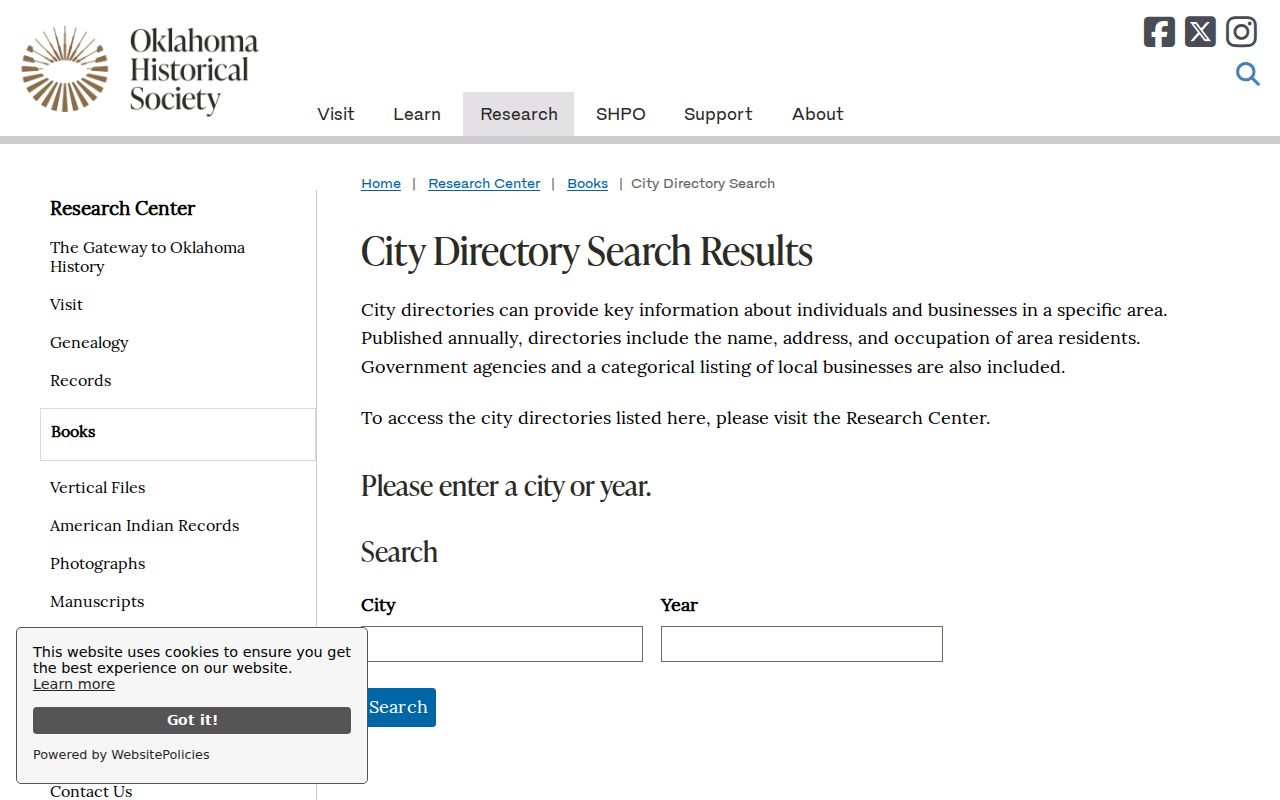
That response is why the Midwest City collection search should be described with a documented online gap, not as a complete digital series.
Midwest City Research Records
The Midwest City Metro Library branch at 8143 E Reno is a practical place to move beyond a web query. Its listed hours are Monday through Thursday 9 to 9, Friday 9 to 6, Saturday 9 to 5, and Sunday 1 to 6. Computers, Wi-Fi, printing, fax and scanning, interlibrary loan, and staff research help make it useful when a catalog hit needs to be read or copied. The branch began in a former golf clubhouse at 3210 Belaire in 1955, expanded or moved in 1964, joined Metro in 1965, and opened its current 36,000-square-foot building in 1987.
The Metro Library Special Collections route covers Oklahoma City, Oklahoma County, and Oklahoma material through photographs, postcards, interviews, digital collections, and finding aids. The Oklahoma Room is listed Monday through Friday, 9 to 5, and an appointment is advised for material or in-depth assistance. The listed contact is Special.Collections@MetroLibrary.org.
A view of Metro Library Special Collections shows the local-history access route.
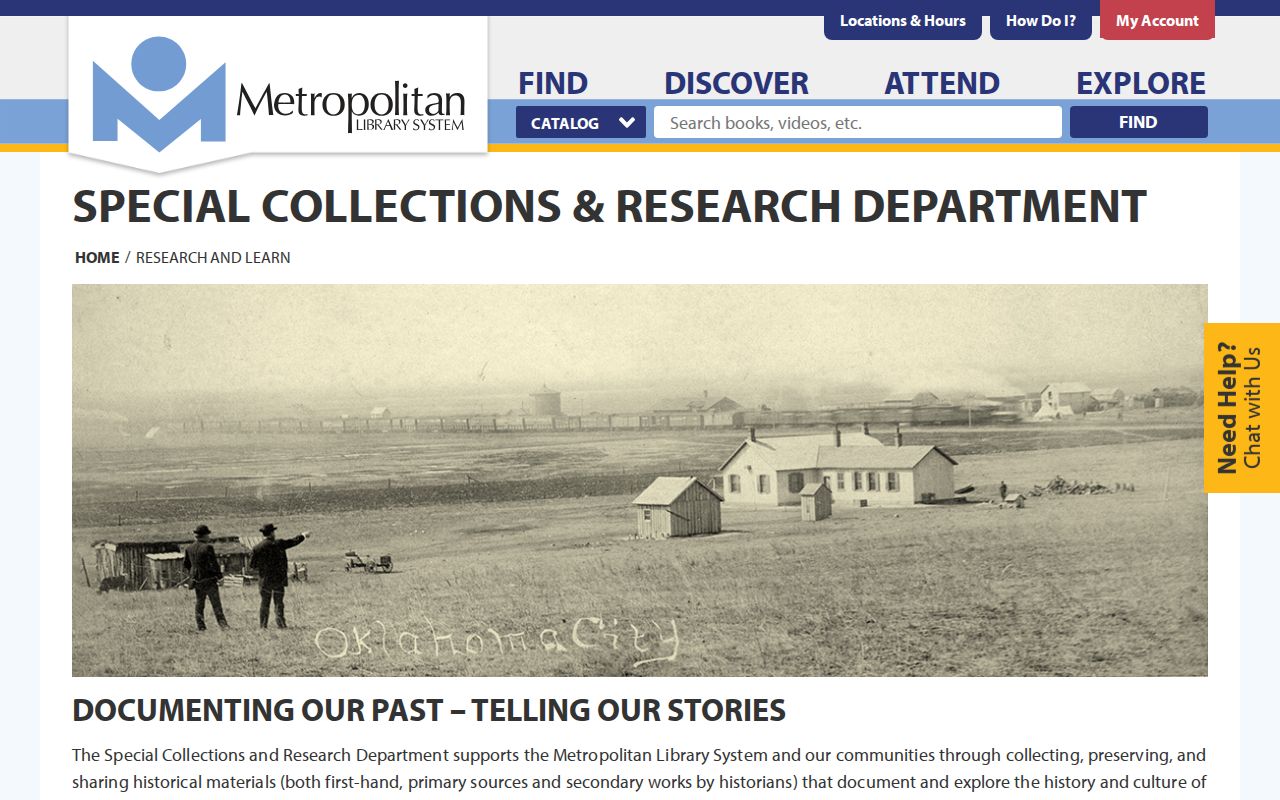
Special Collections is a research lead, not a promise of a Midwest City volume by year, so ask for a collection or finding aid before assuming one is available.
Midwest City Yearbook Records
When a city-directory search does not return a Midwest City volume, school yearbooks can give a dated community lead. The OHS genealogy and yearbook resources list Midwest City High School for 1945, 1949, 1952, 1953 through 1955, 1968, and 1994 through 1995. Other listed entries include Midwest High School for 1948, Monroney High School for 1973, Monroney Junior High for 1963, 1967, and 1972, and Schwartz Public School for 1978 through 1980.
A yearbook may supply a name, class, organization, or image at a known date. It does not verify a street address. Pair it with a dated newspaper, directory entry, or property record before placing a household at a location. This distinction is especially important in a city shaped by postwar growth and ties to the Tinker area, where school and regional references may cross municipal lines.
Reading Midwest City Entries
No actual local entry was exposed in the official online index, so the safest inventory comes from the OHS home-history guidance. Where a volume is available, inspect the title page, publication date, street coverage, and abbreviation key before using an entry. A directory can show a name, street address, spouse or relationship notation, and in some volumes a clue about ownership or nearby listings. The record still needs a date label and a statement of what the volume actually shows.
| Name line | Copy the spelling and initials as printed, including any relationship notation. |
|---|---|
| Street line | Capture the house number, direction, street spelling, unit detail, and the volume year. |
| Relationship clue | Note a spouse or similar notation only as printed, without treating it as an address confirmation. |
| Ownership or nearby material | Some directories include ownership or neighboring material in back pages; check the volume before relying on it. |
| Publication context | Keep the title, repository, page, abbreviation key, and whether the item is an index, scan, or transcription. |
Terms vary by publisher, and some terms describe the book rather than a person. The glossary below keeps the index structure separate from the historical conclusion.
- Criss-cross directory
- A street-order portion of a directory, when present, that can place entries by address rather than alphabetically.
- Householder index
- An aid that groups an entry under a household head in volumes that provide one; it is not guaranteed in every title.
- Abbreviation key
- The publisher's explanation of shortened terms. Photograph or transcribe it before interpreting any mark in a listing.
Midwest City Gateway Records
Gateway to Oklahoma History is not an address register, but it can fill the space around a directory result. Search a name and an address, then repeat a numbered street with the number spelled out. The search may surface notices, marriage or divorce items, birth announcements, social material, crime reporting, photographs, maps, or city records. Describe the item type exactly. A social notice at an address can be a dated connection without proving a long-term household.
The digitized Gateway item titled “Towns - Midwest City - Government” is dated June 1976.
Its title, date, collection, identifier, description, thumbnail or full image, and rights note are useful metadata fields, while the item itself is not a resident entry.
Midwest City Records Timeline
Dates help keep regional material in the right place. The sequence below combines the documented regional directory range, Midwest City's development, and the library history. It does not create a missing local index run.
- 1889: OHS identifies Oklahoma City regional directory holdings beginning with an 1889 title.
- 1942: Midwest City was founded as a military-support community near Tinker Air Force Base.
- 1945-1955: Listed Midwest City school yearbooks begin during the early city era.
- 1955, 1964, 1965, and 1987: The local library opened, changed location or expanded, joined Metro, and then opened its current building.
- June 1976: Gateway's Midwest City government item provides a dated digital archive marker.
Regional Oklahoma City volumes from 1889 through the 1940s have value as nearby context, but their publisher changes do not establish a Midwest City city-directory publication history.
Midwest City Home Records
The OHS home-history guide supplies a disciplined way to connect a house to historical collections. Start with the assessor's name or address search, preserve the subdivision and legal description, then use the County Clerk deed chain because an assessor history can be incomplete. Historical volumes may add a dated address or relationship clue, while Sanborn maps can show a building footprint or use. OHS holds more than 3,000 maps for Oklahoma towns, and Metro Library subscribers can access Oklahoma Sanborn maps with a library card.
The official home-history guide shows the source order behind this Midwest City city-directory work.
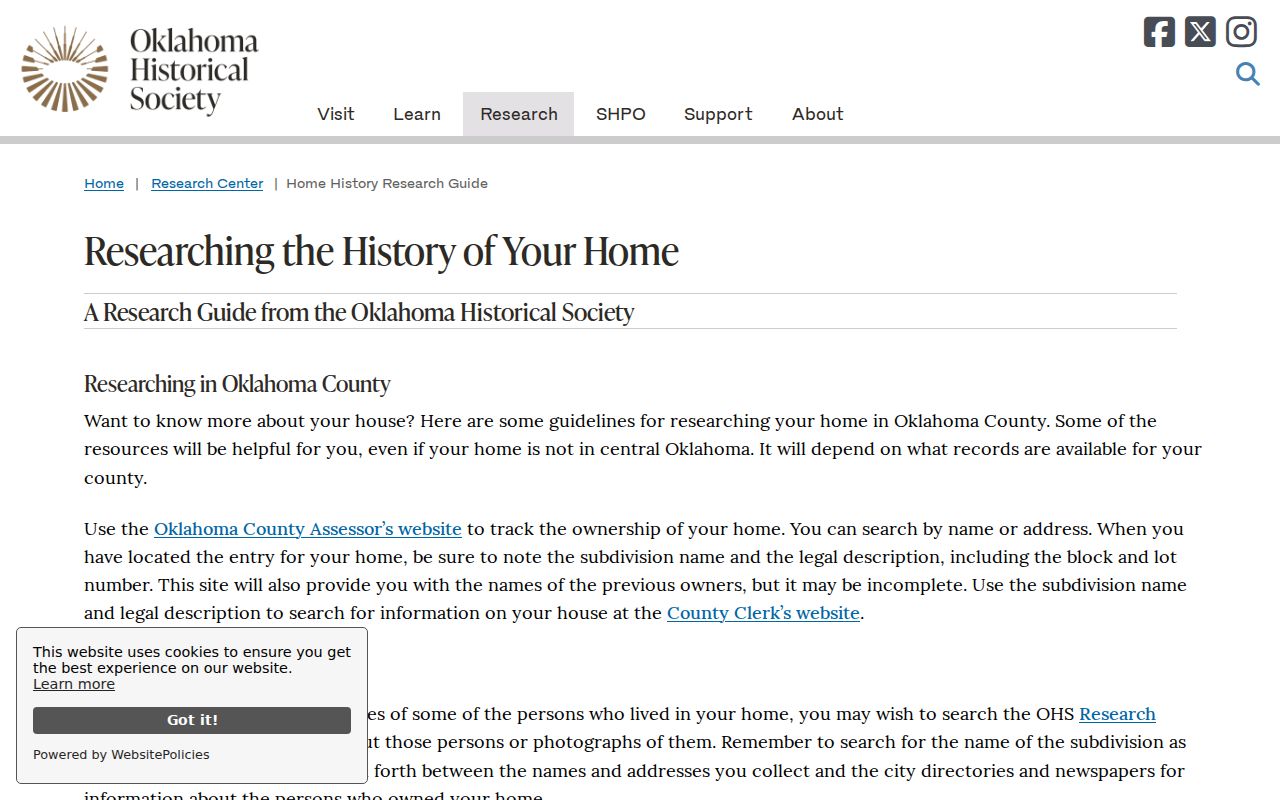
Using the legal description alongside the street address helps bridge an older deed, map, newspaper notice, or directory entry that does not use modern address wording.
Midwest City Household Records
A household trail should move by dated evidence, not by a name alone. Start with the earliest available entry, record how the name and address appear, then compare the next available volume or historical source. The historical collections may have irregular gaps, and a missing name can reflect a move, a spelling change, a publication gap, a different postal form, or an unindexed item. The right conclusion is often “not located in this source,” not “never lived there.”
- Search the OHS directory form by Midwest City and preserve the no-match result if it appears.
- Search a person and address in Gateway, using both numeric and spelled-out street numbers.
- Check the relevant listed yearbook by school and year for a dated community lead.
- Use the assessor and County Clerk records to keep the parcel's legal description distinct from a historical mention.
- Ask OHS or Metro staff for the exact collection, finding aid, microfilm, or reading-room route behind an unresolved lead.
For a later life event, the OHS genealogy listings can point to date-bounded probate, funeral, obituary, divorce, or death material. Match the repository and date range to the question, then retain the source date and relationship label with every conclusion.